🔹 Join the OracleApps88 Telegram Group - Stay up to date with the latest on Oracle EBS R12 and Oracle Cloud/Fusion Applications. 📌 Telegram Group : https://t.me/OracleApps88

💡 Facing issues copying code/scripts or viewing posts? We're here to help!
📬 Contact on Telegram : https://t.me/apps88
📱 Telegram/WhatsApp: +91 905 957 4321
📧 Email Support: OracleApp88@Yahoo.com
Showing posts with label AP. Show all posts

Tuesday, June 9, 2020

AP - Oracle Payables Interview Questions and Answers (FAQ)


1. Types of Invoices in Oracle Apps
Answers :
Standard
Prepayment
Expense Report
Mixed Invoice
Credit Invoice
Debit Invoice

2.What is Mixed Type Invoice in Oracle Apps
Answers :
Mixed Invoice is one of the invoice type in the Oracle Payables. You can enter both the Negative and the Positive Amount for this Mixed Type Invoice. This Payment type is not rigid like Standard, Prepayment, Credit & Debit Memo Invoices to enter the amount in the specific signs (Positive or Negative) .

3. Difference Between the Manual Hold and the System Hold.
Answers :
System Hold apply to the Invoice if Something Mismatched in the Invoice as per the Standard Process Like Invoice Header Total and Line Total Should be Equal Other System Hold for Example related to Invoice Matching If Something goes about the Invoice Tolerance Limit then System Put the Hold. System hold is something related to setup Controls. But Manual Hold is something which put manually in the Invoice due to any reason like Product received from the Supplier is Damaged so need to hold the Payment for that Invoice.

4. What is Pay Alone in AP Invoice?
Answers :
Pay alone is something related to Invoice Payment. This is the Flag we set for AP Invoice, It Means this invoice will be paid alone. For example, Supplier A has 3 Invoices, but for 1 Invoice we have enabled the Pay Alone Flag Then When we will run the Payment Batch then System will create one Check for two invoices and Separate one Check for Pay Alone Invoice. This Is the Working of Pay Alone.

5. Can We pay the AP invoice before Due Date?
Answers : 
Yes, we can Pay the Invoice Before Due date. For Manual Payment, there is no concern but for Payment Batch, When we are running the Payment Process Request then we need to Enter the Pay Through Date this Date is Very Important, If we have set the Pay Through Date “07-Dec” then this Payment Request will pick only those AP invoices which has been due before “07-Dec-2018”.

6. How AP Invoice Payment Due Date Calculates in Oracle Payables
Answers :
Invoice Payment Due date depends on the Two Factors.
1.Payment Terms attached to the Invoice
2. Invoice Date.
For Example, if Payment Terms is 30 Days and the Invoice Date is 12-Dec-2018
Then Payment Due Date Will be : 12-Jan-2019

7. What is Primary and Secondary Ledger in Oracle Payables ?
Answers :
Primary Ledger is the Main Ledger and Secondary Ledger is the Replica of the Primary Ledger. We Do transactions in the Primary Ledger. The main reason of using Primary and Secondary Ledger is the difference in the Organization Requirement and the Statuary Requirement. For example, One US based company office is in India and as per US Company, their Calendar works from Oct to Sep but the in India their calendar works from Apr to Mar SO in this Kind of Requirement, Primary and Secondary Ledger concept comes. Where we can design the Primary calendar as per the US based but can design the Secondary calendar as per India Statuary Requirement. 

8. What is Recurring Invoice in Oracle ?
Answers :
As its name represents ‘Recurring’. Recurring means again and again. If any Organization books the Office rent invoice every month for the same amount or any other fixed expenses every month then oracle has provided the Recurring Invoice. We just need to do the recurring Invoice setup for that amount and system will create the invoice automatically on the First day of the Months.

9. What is the Use of Payables Trial Balance report ?
Answers :
Payables Trial Balance Report shows the Total Liability or the Supplier Outstanding in the System. This Report shows the Liability in the System supplier and Site Level. This Provide the Summary Information’s for all the Unpaid amount for the Supplier Invoices which are validated.
  
10. What we do in the AP and GL reconciliation ?
Answers : 
In the AP and GL reconciliation, we try to Match the Total Liability from the Payables with the Liability accounts total in the GL. We have some set of Liability accounts in the Payables, which we only use in the Invoice Headers to book the Liability and we match only these Liability GL accounts in the AP and GL reconciliation report.
We took the help of Payables Trial Balance report to find the Total AP liability and then Run the GL Trial Balance report to match the Payables Trial Balance Report Total with the GL trial Liability Accounts.

11. Distribution Set in Oracle Payables
Answers :
Distribution set is the combination of multiple Distribution lines using different -2 GL accounts Combination. For Example , We booked most of the AP invoices in two different GL accounts combination so each time we need to enter two lines in the invoice distributions to book the AP invoices expenses in these two GL accounts but this process can be make query quickly and easy. Oracle have functionality like Distributions set in oracle payables where we can any number of GL accounts line for a Given Distribution sets and then in the Oracle Payables Invoices we don’t need to create Distribution lines manually. We just need to enter the Distributions Set in the Ap invoice Lines and oracle system automatically creates the Invoice distribution lines with GL accounts given in the distribution set in oracle payables r12.

Saturday, August 24, 2019

Fusion Expenses – Oracle Fusion Expenses Training Manual

Oracle Fusion Expenses is a complete, end-to-end solution for digital expense management giving employees easy data entry options, and financial managers detailed spend information and policy-driven control.
Online and mobile, along with spreadsheet entry options, automate travel entry and approvals, reducing administrative headaches while capturing essential data for effective cost management.

STREAMLINE EXPENSE PROCESSING AND REDUCE COSTS
Oracle Expenses Cloud provides your organization with the tools to effectively manage the travel and expense process. With flexible payment options, versatile data entry methods, and personalizable user preferences, Oracle Expenses Cloud lets you enter, submit, approve, audit, and pay expense reports quickly while enforcing transparent, tight controls throughout your expense management process.

The Travel and Expenses work area provides a clear overview of the status of your expense items, reports, cash advances, trips, and items that require action. This information is summarized into infotiles that deliver clear, accurate and actionable information when you need it. Items requiring your action are highlighted in red, guiding you to take immediate action and make effective decisions.

SIMPLIFY EXPENSE REPORTING AND INCREASE COMPLIANCE
Oracle Expenses Cloud offers extensive functionality to increase workforce productivity and satisfaction. For example, employees can quickly and easily enter and submit expense reports for corporate card transactions along with cash expenses. Pre-populating reports with card transactions makes expense entry faster, increases data accuracy and reduces opportunities for fraud.

Users expect their corporate systems to reflect the prevalence of digital technology in their personal lives. To accommodate the increasing use of mobile devices, Oracle offers expense capture, submission and approval on the go. Fusion Mobile Expenses is a comprehensive solution supporting mobile entry for both iPhone and Android devices, leveraging common smartphone features such as photo capture for automated expense entry of receipts, voice capture to record expenses, GPS route tracking to calculate mileage, and multi-currency and location-based support using GPS location. Other innovative features use your contacts and calendar to select attendees for meals or other expenses.

STREAMLINED TRAVEL INTEGRATION
Integration between the travel partner, GetThere, and Oracle Expenses Cloud improves the employee booking experience and provides visibility to travel costs and travel policy violations. The travel booking site is accessible directly from the employees’ Travel and Expenses work area and when a trip is booked, the trip data is automatically downloaded to the Expenses Cloud application, making it quicker and easier to create expense reports based on the trip details.

Managers, other approvers, and auditors can view the difference in the booked versus actual expense, as well as any booking policy violations with justifications. This helps approvers and auditors monitor travel costs and ensure that employees are in compliance with corporate travel policies.

Key Features
• Mobile entry for expenses
• Seamless integration with Get There and corporate credit cards
• Support for global Per Diem requirements
• Automated support for accounting and project allocations
• Embedded transactional intelligence that guides approvers’ decisions
• Out-of-the box imaging integration
• Unique approval routing for project and cost center expenses

• Integration with established payment processes and applications

Below are the setups and Process flow

Configuring Security
            01: Creating an Employee
            02: Adding Expense Roles to Your User

Configuring Oracle Expenses with Rapid Implementation          
            01: Reviewing Expenses System Options
            02: Creating an Expense Report Template
            03: Reviewing Approval Rules (Demonstration)
            04: Setting Warning and Error Limits on a Conversion Rate (Demonstration)
            05: Viewing a Conversion Rate Policy Warning and Error

Entering Expense Items and Expense Reports       
            01: Touring the Simplified Work Area
            02: Creating an Expense Report
            03: Marking an Expense Item as a Recurring Expense
            04: Adding a New Primary Bank Account
            05: Adding a Delegate to the Delegate and Permissions Page

Defining Expense Policies and Rules         
            01: Setting Up a Car Rental Expense Policy
            02: Setting Up an Accommodations Expense Policy
            03: Setting Up a Meals Expense Policy
            04: Setting Up a Miscellaneous Expense Policy
            05: Setting Up an Airfare Expense Policy
            06: Setting Up a Mileage Expense Policy

Configuring Credit Card Data        
            01: Creating a Corporate Card Program
            02: Setting Up a Corporate Card Usage Policy Warning (Demonstration)

Setting Up Receipt Management    
            01: Creating Receipt and Notification Rules

Auditing Expenses   
            01: Creating an Audit List Rule
            02: Adding an Employee to the Audit List
            03: Selecting Audit Selection Rules (Demonstration)
            04: Rejecting an Expense Report on Audit (Demonstration)

Configuring and Requesting a Cash Advance       
            01: Configuring Cash Advances (Demonstration)
            02: Requesting a Cash Advance

Processing Expense Reimbursement and Capturing Tax  

Managing Contingent Workers       
            Data Demonstration
            Creating and Submitting an Expense Report (Demonstration)

Processing Third-Party Expense Reimbursements

Setting Up Travel     
            01: Setting Up Travel Integration (Demonstration)
            02: Creating and Importing a Trip Itinerary

Mobile Devices        
            01: Setup Steps
            02: Entering Expenses Using Quick Entry
            03: Entering Expenses Using Voice Recognition
            04: Using the Camera to Create an Expense Line
            05: Submitting an Expense Report

Analyzing and Reporting on Expenses       
            1: Creating Ad Hoc Reports for Expenses


Please click on the below link for more details:

Fusion Expenses – Oracle Fusion Expenses Training Manual


Please Like and Share our FaceBook page to get more details on Oracle Applications


Monday, July 22, 2019

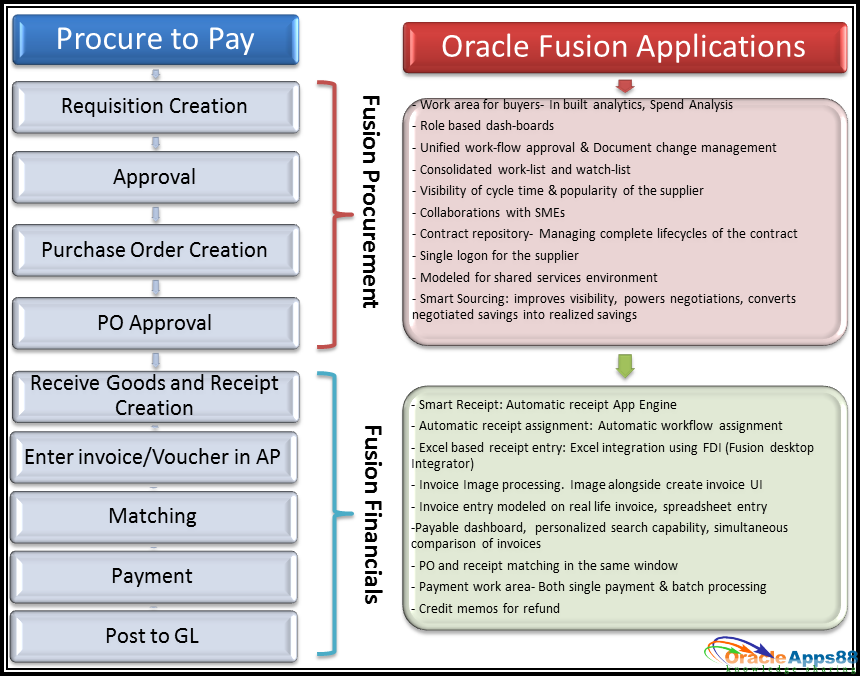
Fusion P2P – Oracle Fusion Procure to Pay (P2P) Life Cycle with Functional and Technical flow


The Procure to Pay cycle is vital to an organization as in this process the organization buys and received goods or services from its vendors and makes necessary payments.

The key functionalities for different processes of the Procure-to-Pay cycle are:
In-built intelligence with business transactions--Role based dash boards and work area for buyer, approver; presenting the statistical report, trend, spend analysis, personalized search capability

Enhanced sourcing capabilities--Supplier analysis, visibility of supplier lead time and popularity across departments

Supplier self-service-- Single log-on for supplier providing complete visibility to their transactions and full invoicing capability

Standardized processes -- to facilitate shared services model and centralized procurement function

Smart Receipt capabilities-- Automatic receipt application engine, Over/Under payment rules, scored recommendations based on customer, transaction or exceptions, centralized approach for receipt processing, setup rules to match receipt to the specialist for manual intervention and rules to mark the priority of the receipt based on attributes

Payable dashboard--To collaborate with various participants, visibility of priority items and work volume, item tagging option for quick retrieval

Invoice Work Area-- Invoice creation from scanned images, exception resolution, Invoice creation in a format based on real life physical invoice offering easy data entry and audit

Integrated invoice image processing-- Image attached with the invoice throughout invoice life-cycle

Invoice indicators--Out of balance, status and hold, prepayment alert during entry

Voucher matching -- with the receipt and PO in the same window 

Personalized view-- Excel like capability to freeze columns, personalized search, full screen view, export to excel

One of the best characteristics of the Oracle Fusion applications is that these can be fully integrated with traditional Oracle ERP solutions like PeopleSoft, Oracle EBS. So the existing Oracle customers can choose to implement module wise and selective Fusion functions too. 
                                                                   
With the in-built business intelligence capabilities and business benefits of cloud based applications; Oracle Fusion financials and procurement definitely equip the finance and purchasing users to play a bigger role and add value in overall business achievements. 


The P2P cycle comprises of the following steps,
01. Create Requisitions
02. Approve Requisitions
03. Create Purchase Orders
04. Approve Purchase Orders
05. Receive Goods
06. Create Payables invoice with Match PO Lines
07. Approve Invoice
08. Invoice Payment to Supplier with Electronic Method
09. Approve Payments
10. Verify the Transaction Life Cycle
11. Transfer Payables data to General Ledger
12. Transfer Payments data to General Ledger
13. Verify the Journal Batches
14. Verify the Notifications in Mail


Please click on the below link for more details:

Fusion P2P – Oracle Fusion Procure to Pay (P2P) Life Cycle with Functional and Technical flow


Please Like and Share our FaceBook page to get more details on Oracle Applications
https://www.facebook.com/pages/Oracle-Applications/712588392100243

Saturday, July 20, 2019

AP – Oracle Fusion Payable and Payments (ACH, Check) Setups and Process Training Manual

Payable Setups
  Setup the Manage Procurement Agent
  Supplier Registration without Bank Details
  Add the Bank Account to the Supplier
  Invoice, Payment Approval Setups (Optional)
  Bank, Branch and Bank Account Setups
Understanding Payables Dashboard

Invoice Creation
  Standard Invoice
  Credit Memo Invoice
  Credit Memo Invoice with Matching to Standard Invoice
  Debit Memo Invoice
  Debit Memo Invoice with Matching to Standard Invoice

PO (Purchase Order) Matched Invoices
  Creating a Purchase Order for Apply to Standard Invoice
  Creating a Standard Invoice and Match the Above Purchase Order
  Creating One Invoice Matched to Multiple Purchase Orders

Invoice Holds
  Placing a Manual Hold on an Invoice
  Releasing Invoices from a System Hold
  Placing a Manual Hold on an Invoice Lines
Cancelling an Invoice


ACH (Electronic) Payment Setups and Process Flow
ACH Payment Setups
  1.BI Publisher Desktop
  2.Payment Setups
    a.Payment Templates
    b.Payment Formats
    c.Payment Document (For Electronic payments this setup is Optional)
    d.Payment Process Profile (PPP)
    e.Payment Process Request Template (Optional)

  ACH (Electronic) Payment Process Flow
  1.Create Invoice and Pay in Full
  2.Manual Payment
                Create invoice and submit the Manual Payment
               
  3.Run the Payment Process Request (PPR)
                Create Invoice
                Void the Payment (Cancel the Existing payment)
                Create the PPR for New Invoices and Void Payments
               
  4.Accounting
                Post the Invoice to General Ledger
                Post the Payment to General Ledger
 

Check Payment Setups and Process Flow
   Check Payment Setups
    1.Payment Setups
      a.Payment Templates
      b.Payment Formats
      c.Payment Document (For Electronic payments this setup is Optional)
      d.Payment Process Profile (PPP)
      e.Payment Process Request Template (Optional)

  Check Payment Process Flow
    1.Create Invoice and Pay in Full
    2.Manual Payment
      Create invoice and run the Manual Payment
   
    3.Run the Payment Process Request (PPR)
      Create Invoice
      Void the Payment (Cancel the Existing payment)
      Create the PPR for New Invoices and Void Payments
   
    4.Accounting
                  Post the Invoice to General Ledger
                  Post the Payment to General Ledger


Setup the Manage Procurement Agent
Procurement agents are typically users with procurement roles, such as:
Buyer
Catalog Administrator
Category Manager
Procurement Contract Administrator
Procurement Manager
Supplier Administrator
Supplier Manager
Supplier Qualification

They have procurement job responsibilities in the buying organization, such as creating purchase agreements, purchase orders, and related procurement functions. You must set up these users as procurement agents for them to manage procurement documents and perform other procurement actions.
You use the Manage Procurement Agents task to create and maintain a procurement agent's access to procurement functionality for a business unit. You can find the task in the Purchase Agreements and Purchase Orders work areas.

You can implement document security for individual document types, such as purchase orders, purchase agreements, and requisitions. You can also control a procurement agent's access to manage activities for suppliers, negotiations, catalog content, and business intelligence spend data.
The configuration assigns an access level to documents owned by other procurement agents for each procurement business unit.

Note: An agent can perform all actions on his own documents as long as he has procurement BU access.
None: The agent has no access to documents owned by other agents.

View: Permits the agent to search and view other agents' documents.
Modify: Permits the agent to view, modify, delete, and withdraw other agents' documents.
Full: Permits the agent full control of other agents' documents. This includes the view, modify, delete, withdraw, freeze, hold, close, cancel, and finally close actions.
The buyer agent is granted access to the Manage Supplier functionality in the Manage Procurement Agent page
- Login with an username with access to Functional Setup Manager
- Select Functional Setup Manager (FSM) face
- In All Tasks Tab, search for "Manage Procurement Agent"
- Click on Manage Procurement Agent task
- Click on the Agent Name to Edit the Agent
- Under Action, grantee the "Manage Suppliers" privilege to the agent
By default, the suppliers for which the agent is granted access is based on the business unit setups. And Supplier Sites are assigned to certain business units in the site assignments.
All of these setups work together to determine which suppliers and supplier sites the buyer agent can manage or view.

If you have France setup as a Business Unit and Italy setup as a Business Unit you may control the access via the Business Unit setup for the buyer agent, or otherwise you may control the access at the individual Supplier Site setups.

Supplier Creation and Maintenance
After login to instance, click on Home Icon.


Please click on the below link for more details:
AP – Oracle Fusion Payable and Payments (ACH, Check) Setups and Process Training Manual
https://drive.google.com/file/d/1kmoZp1GbG2jymB3eEeJpsicdJOr5BMDX/


Please Like and Share our FaceBook page to get more details on Oracle Applications
https://www.facebook.com/pages/Oracle-Applications/712588392100243
If you are facing any issues while copying the Code/Script or any issues with Posts, Please send a mail to OracleApp88@Yahoo.com or message me at @apps88 or +91 905 957 4321 in telegram.
Best Blogger TipsGet Flower Effect